The Challenge
The Birch Aquarium hopes to portray scientists and oceanographers as explorers with the passion to better understand environmental phenomenons. These oceanographers embark on week or month-long trips to make detailed studies, whether it be measuring chemicals in the water or studying coral changes. However, this isn’t the typical portrayal of scientists. Popular media has repeated shown the image of scientists as wearing white lab coats and holding glass beakers. Through stories, personal motivations and challenges, our team will work with the aquarium to design an exhibit that humanizes scientists and challenges these stereotypes.
The Goal
A well-designed exhibit should be engaging, family-friendly, and informative. After interacting with this exhibit, visitors should feel that they are able to relate to the scientists and understand the passion and motivation behind their work. Ultimately, we want the visitors to realize the importance of the work and be inspired to take part in protecting the planet.

On-Site Observations
Our team visited the Birch Aquarium to observe visitors' experience in the aquarium space. Through my observations, I hoped to find what made certain exhibits appealing to the visitors.
Visual attraction. Visitors loved the expansive floor-to-ceiling glass tank. Their eyes filled with wonder as they watched the school of fish zooming across the tank or the long seaweed flowing in the water. Kids pressed their noses and hands against the glass to get a look at the sea turtle swimming by.
Physical interaction. Kids gravitated towards any exhibit that had a button, lever, wheel or anything they can get their hands on. They were eager to interact with the exhibit and find out how it will respond. To them, the novelty and unexpected made the interaction engaging.
Surveys
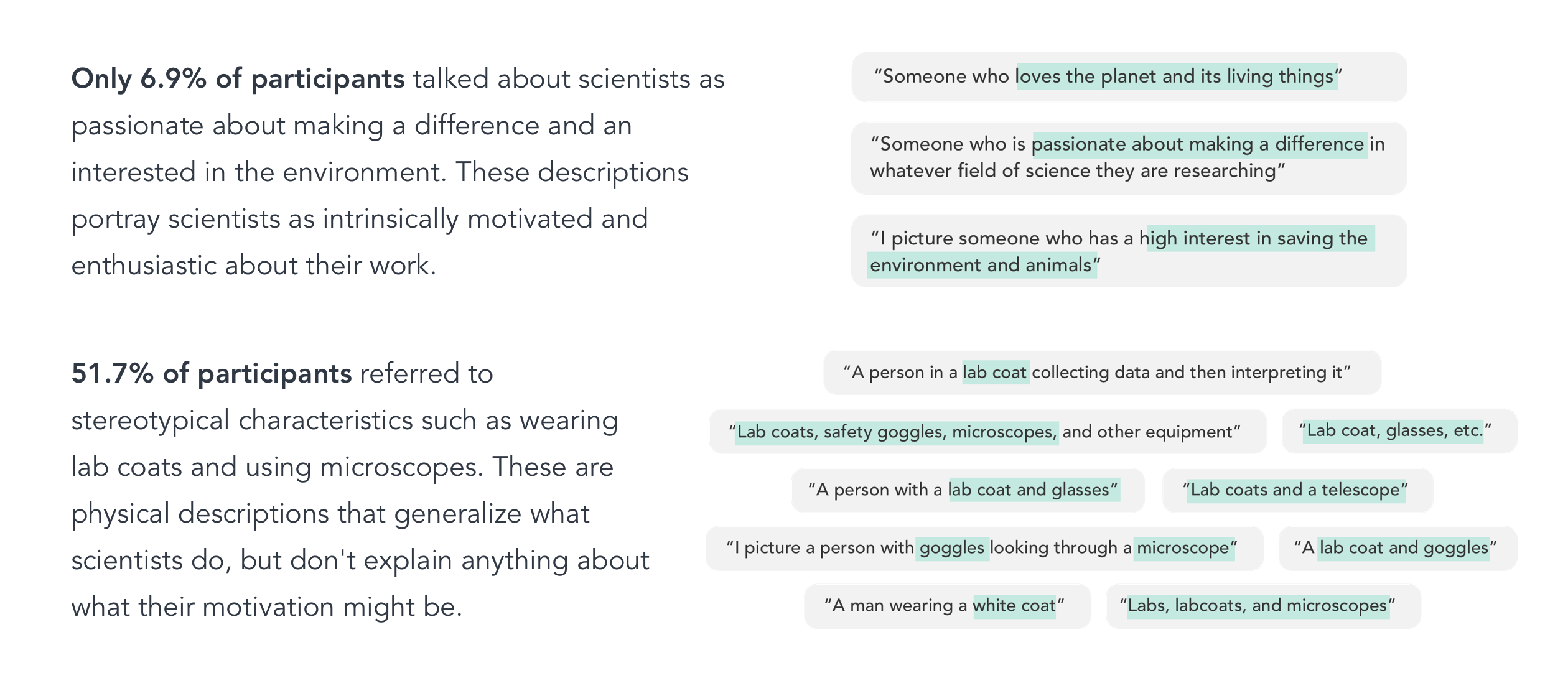
With the goals of breaking current stereotypes, I wanted understand how people currently view scientists. I created a survey asking participants this question:
"What comes to mind when you imagine a scientist?"
Survey details: 58 participants | ages: 14-22 | 57.4% Female 37.7% Male 4.9% Other
Interviews
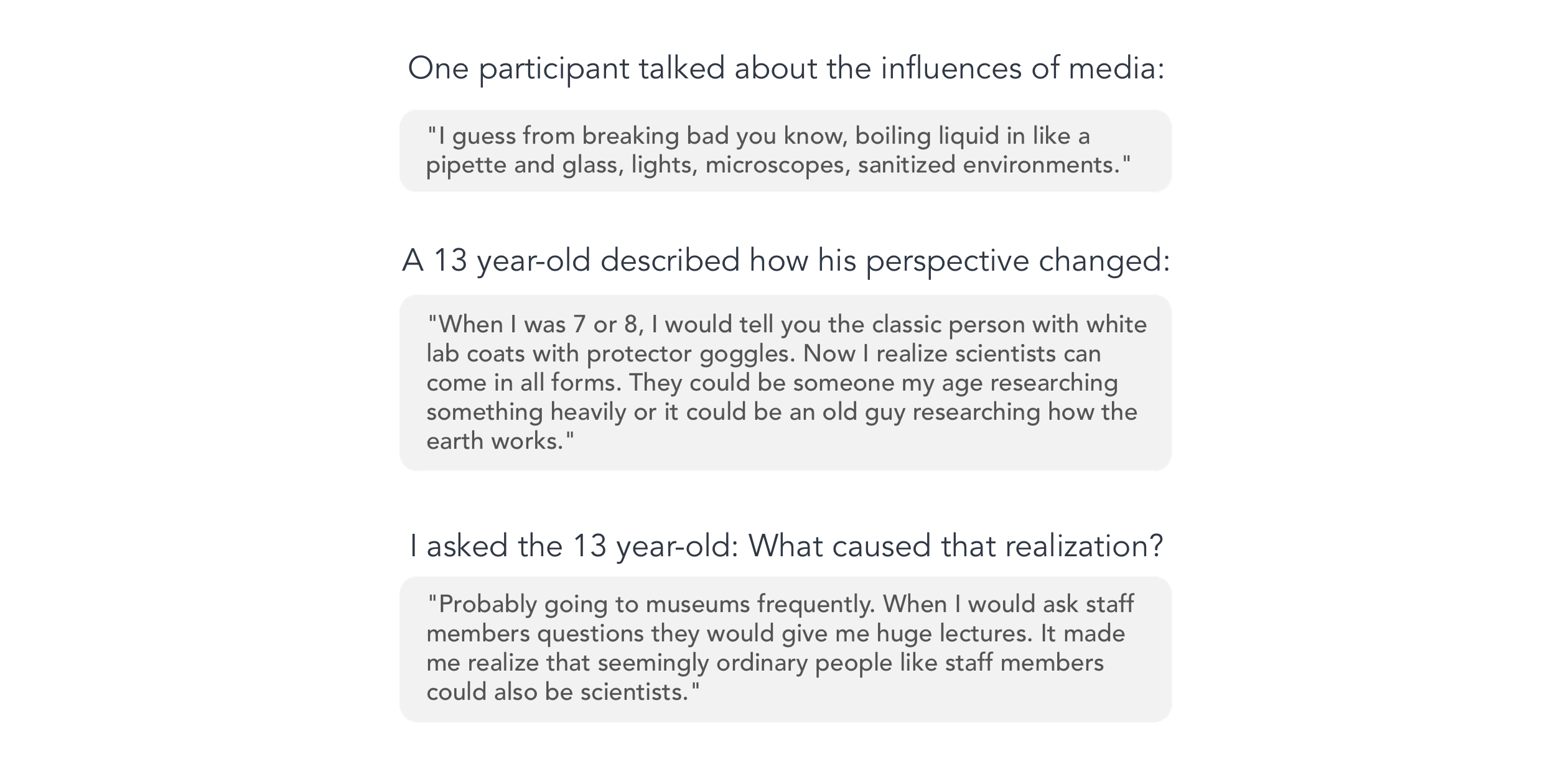
How do people currently think of scientists? Posing the same question, I received similar trends of responses in the interviews. However, I was able to converse with the participants and dig deeper into possible influences of their perspectives.
Prototype
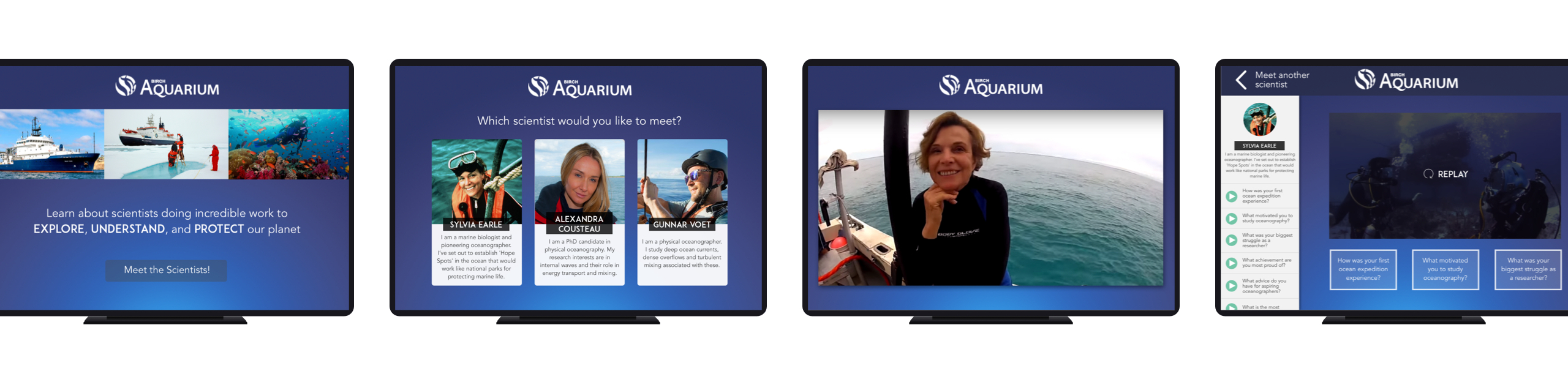
Knowing that personal stories can humanize scientists and make them more relatable, the design challenge was to incorporate this insight into a prototype. In an ideal scenario, we would ask scientists to visit the aquarium and invite full interactions with the visitors themselves. However, this would be difficult to arrange logistically. What if we could simulate a conversation with the scientists instead?
Design concept: One approach would be to interview a scientist and ask them questions such as "What motivates you to study in your field?" and "What impact do you hope to make?" This gives them an opportunity to tell the untold stories about their passion and their work. With permission, we would videotape the interview and use it as part of the exhibit. A visitor can interact with the digital exhibit, choose which scientist they'd like to learn about, and get to know them by selecting one of the displayed questions. Then, they will be shown a video of the scientist answering that question.
Design Goal: Spark a connection and interest by hearing the first-hand experiences of a scientist. The stories that differ from the stereotypical images can expand the views of scientists, showing variety of topics, tools, and environments they work with. Furthermore, hearing the struggles and success brings out the imperfection that shows a more authentic perspective of the profession.
Prototype Testing
Do aquarium visitors see scientists in a new light and have a more well-rounded perspective of them? Our team went back to the Birch Aquarium and asked interested visitors to test out the prototype. My goal was to get feedback on whether the exhibit prototype effectively addresses the design challenge. I received a wide range of responses from different user types.
Children: Children were easily distracted when watching the interview-style videos. Watching someone talking to the camera was not visually appealing, even if the content may be interesting. Some kids didn't fully understand what was being said.
Teenagers: Teenagers were interested by the stories. They listened attentively and were eager to ask more questions. They told me that they learned novel and unexpected things about scientists. "It was nice to hear the scientist in her own voice,” she said.
Parents: Since the kids were easily distractible, the adults were attending to their kids and had difficulty focusing. We have to capture the kids' attention to even get a chance at catching the parents'.
Moving forward, we brainstormed ways to improve the prototype. The interactive component was present, but the visual component was lacking. We went back to the drawing board and discussed how we can improve the visual appeal and capture the attention of these aquarium visitors.
Prototype Iteration
We iterated on the prototype by modifying the videos themselves. To engage younger audiences, we created an animation video that visually illustrates the stories being told. Drawings are sketched out and words are emphasized in correspondence with the pace of the story, similar to a draw-my-life video.
Final Thoughts
The highlight of this project was the testing of the exhibit prototype in the real aquarium setting. With the help of aquarium goers who volunteered to try the prototype, I was able to see the prototype in the real context. Some interactions were anticipated while other reactions were insightful and informative. With just one visit to the aquarium, I had a better understanding of the parts that were well-received and parts that need improvement.
By bringing out stories told personally by oceanographers, this exhibit can help aquarium visitors understand oceanographers on a more personal level. This essentially builds a sense of empathy and humanizes the oceanographers as scientists who are eager to explore the depths of the ocean as they seek to protect the planet. I am excited and proud to see this project come to completion, as it helps bring to light the aspects of passion, drive, and sacrifice that are often missing from portrayals of scientists.